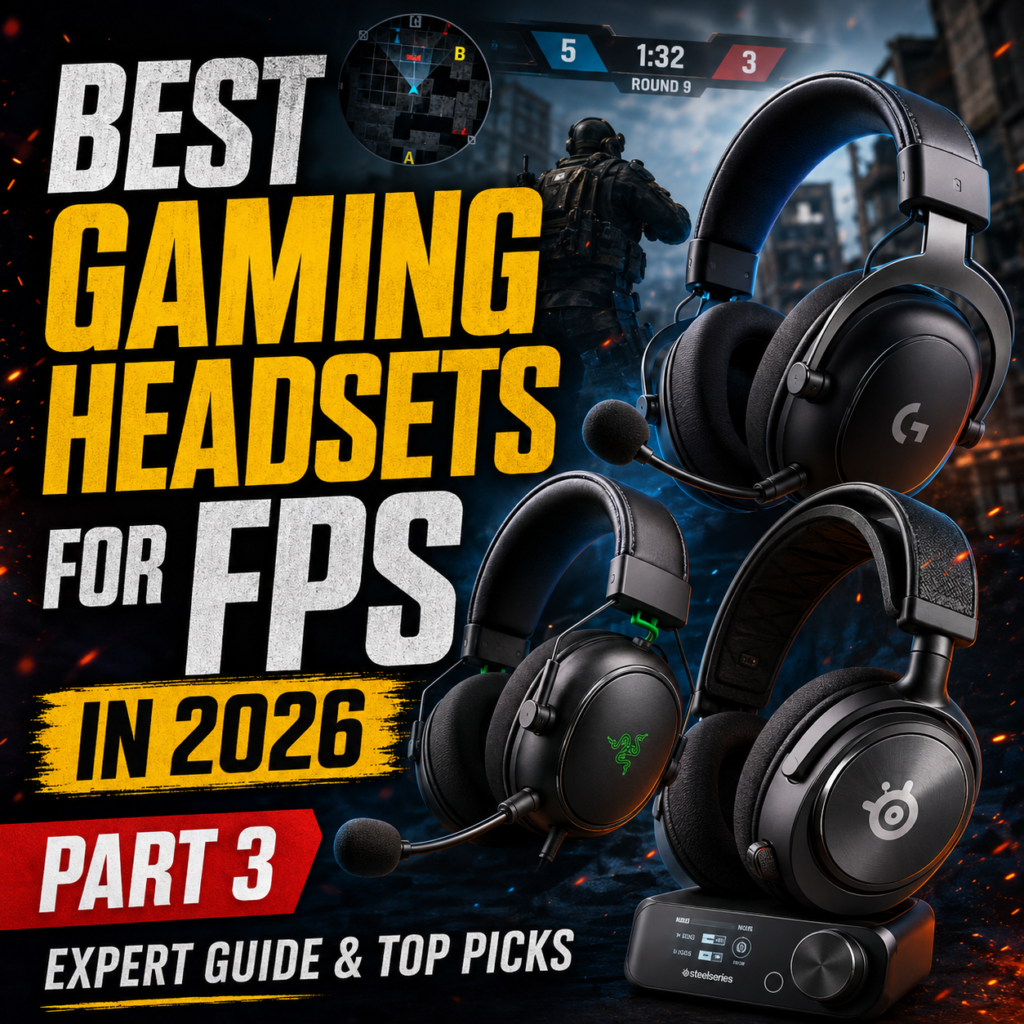
Best Gaming Headsets for FPS in 2026
Hear Every Footstep Before Your Enemy Does
Last Updated: July 2026
If you’re serious about competitive gaming, your headset is just as important as your mouse, keyboard, or monitor.
In games like Counter-Strike 2, Valorant, Call of Duty: Black Ops 7, Rainbow Six Siege X, Apex Legends, and Escape from Tarkov, hearing a single footstep half a second earlier can determine whether you win or lose a fight.
Many players spend over $2,000 on a gaming PC but continue using low-quality headphones. That limits one of the most valuable sources of information in every FPS game: sound.
A quality gaming headset allows you to:
- Hear enemy footsteps sooner
- Identify the direction of movement
- Locate gunfire more accurately
- Communicate clearly with teammates
- Reduce listening fatigue during long gaming sessions
- Gain a competitive advantage without changing your aim
In this guide, we’ll explore the best gaming headsets for FPS games in 2026, explain what features actually matter, compare wired and wireless options, and help you choose the perfect headset for your budget.
Why Sound Matters More Than Ever in FPS Games


6
Modern FPS games rely heavily on positional audio.
Every movement creates valuable information:
- Walking
- Sprinting
- Reloading
- Climbing ladders
- Opening doors
- Throwing grenades
- Weapon swapping
- Jumping
- Sliding
- Zipline movement
Professional players don’t simply react to what they see—they constantly gather information through sound.
Imagine you’re defending a bomb site in Counter-Strike 2.
Before an enemy appears on your screen, you may already know:
- Which direction they’re approaching from
- Whether one or multiple players are pushing
- Whether they’re walking or running
- Whether they’re preparing utility
- How close they are
That information allows you to position yourself before the fight even begins.
Good audio isn’t just immersive—it’s tactical.
What Makes a Great FPS Gaming Headset?


6
Not every expensive headset is great for competitive shooters.
Many products focus on RGB lighting or exaggerated bass instead of delivering accurate positional sound.
The best FPS headsets prioritize:
Precise Imaging
Imaging refers to how accurately a headset places sounds in 3D space.
Excellent imaging helps distinguish whether footsteps come from:
- Left
- Right
- Above
- Below
- Behind
- In front
This is one of the most important characteristics for competitive gaming.
Large Soundstage
Soundstage describes how spacious the audio feels.
A wider soundstage makes enemies seem farther apart rather than compressed into one location.
Benefits include:
- Easier enemy tracking
- Better environmental awareness
- Improved distance perception
- Less audio congestion during firefights
Clear Mid and High Frequencies
Many consumer headphones emphasize heavy bass.
While explosions sound exciting, excessive bass can mask important sounds such as footsteps and reloads.
Competitive players generally prefer balanced tuning with:
- Crisp footsteps
- Clear voices
- Controlled bass
- Detailed environmental sounds
Comfortable Design


6
Competitive sessions often last several hours.
Comfort becomes just as important as sound quality.
Look for features such as:
- Memory foam ear cushions
- Lightweight frame
- Adjustable headband
- Breathable fabric
- Low clamping force
An uncomfortable headset can become distracting during tournaments or ranked matches.
Wired vs Wireless Gaming Headsets


9
One of the biggest debates among gamers is whether wireless headsets are finally good enough for competitive play.
The answer is yes.
Modern wireless technology has improved dramatically.
Today’s premium wireless gaming headsets deliver latency so low that most players cannot distinguish them from wired models.
Advantages of Wired Headsets
- No battery concerns
- Lower purchase price
- Consistent connection
- No charging required
- Plug-and-play simplicity
Wired headsets remain popular among esports players who want absolute reliability.
Advantages of Wireless Headsets
- No cable drag
- Greater freedom of movement
- Cleaner gaming setup
- Easy switching between devices
- Excellent battery life
Many premium wireless models now offer:
- 2.4 GHz ultra-low latency
- Bluetooth connectivity
- Simultaneous dual-device pairing
- USB-C fast charging
- 30–70 hour battery life
For most gamers, wireless no longer means sacrificing performance.
Open-Back vs Closed-Back Headsets


5
Another important decision is choosing between open-back and closed-back designs.
Open-Back
Advantages:
- Wider soundstage
- More natural audio
- Better positional awareness
- Reduced ear fatigue
Disadvantages:
- Sound leakage
- Less bass
- Poor noise isolation
Open-back headsets are excellent for quiet rooms where positional accuracy is the priority.
Closed-Back
Advantages:
- Better noise isolation
- Stronger bass
- Greater immersion
- Suitable for noisy environments
Disadvantages:
- Smaller soundstage
- Slightly warmer ears during long sessions
Closed-back models remain the most popular choice for gaming because they block outside distractions and work well in almost any environment.
Stereo vs Virtual Surround Sound


4
Many gaming headsets advertise 7.1 Virtual Surround Sound as a must-have feature.
However, the reality is more nuanced.
Stereo Audio
Advantages:
- More accurate positioning
- Cleaner sound
- Preferred by many professional esports players
- Lower processing delay
Virtual Surround Sound
Advantages:
- Enhanced immersion
- Better environmental effects
- Helpful for some casual gamers
- Improved cinematic experience
Many professional FPS players actually disable virtual surround sound and use stereo because it often provides more precise directional cues.
The best approach is to try both modes and choose the one that feels most natural to you.
Why Professional Players Invest in High-End Gaming Headsets


6
Professional gamers don’t purchase premium headsets simply because they’re expensive.
They choose them because they provide:
- Better directional accuracy
- Consistent communication
- Comfortable all-day wear
- Reliable microphones
- Stable wireless performance
- Durable construction for daily practice
When you’re practicing eight or more hours each day, comfort and consistency become just as valuable as sound quality.
For casual players, a premium headset enhances the gaming experience.
For competitive players, it’s an investment in performance.
1. SteelSeries Arctis Nova Pro Wireless
Best Overall Gaming Headset


4
Why It Stands Out
The SteelSeries Arctis Nova Pro Wireless continues to be one of the most complete gaming headsets available.
Its combination of premium audio, outstanding comfort, active noise cancellation, and dual wireless connectivity makes it an excellent choice for both competitive and everyday gaming.
Key Features
- Premium Hi-Res audio drivers
- Active Noise Cancellation (ANC)
- Infinity Power dual battery system
- 2.4GHz + Bluetooth simultaneous connection
- AI-powered noise-canceling microphone
- SteelSeries Sonar software support
Pros
✔ Outstanding positional audio
✔ Comfortable for long sessions
✔ Excellent microphone quality
✔ Dual-device connectivity
✔ Hot-swappable batteries
Cons
✘ Premium price
✘ Slightly heavier than some competitors
Best For
- Competitive FPS
- Streamers
- Multi-platform gamers
- Players wanting premium features
2. Logitech G Pro X 2 Lightspeed
Best Wireless Esports Headset


Logitech designed the G Pro X 2 specifically with professional esports players.
Graphene drivers provide excellent detail while keeping distortion extremely low.
The headset is lightweight, durable, and one of the best wireless options for FPS games.
Highlights
- Graphene 50mm drivers
- LIGHTSPEED wireless
- Bluetooth support
- Up to 50-hour battery life
- Detachable microphone
- Excellent imaging
Pros
✔ Extremely lightweight
✔ Excellent imaging
✔ Great battery life
✔ Comfortable ear cushions
Cons
✘ Software can feel overwhelming
✘ No active noise cancellation
Recommended For
- Counter-Strike 2
- Valorant
- Rainbow Six Siege X
- Apex Legends
3. Razer BlackShark V2 Pro (2023)
Best Competitive FPS Headset


6
The BlackShark series has become extremely popular among professional FPS players.
Its tuning focuses on clarity rather than overwhelming bass.
Footsteps remain easy to identify even during chaotic firefights.
Features
- TriForce Titanium drivers
- HyperClear Super Wideband microphone
- THX Spatial Audio
- Low-latency wireless
- Lightweight construction
Pros
✔ Exceptional footstep clarity
✔ Excellent microphone
✔ Very comfortable
✔ Great wireless performance
Cons
✘ Limited Bluetooth features
✘ Premium pricing
Best Games
- Valorant
- Counter-Strike 2
- Escape from Tarkov
4. Audeze Maxwell
Best Audio Quality


If absolute sound quality matters more than anything else, the Audeze Maxwell is difficult to beat.
Instead of traditional dynamic drivers, it uses planar magnetic drivers, delivering exceptional clarity, detail, and accuracy.
Music, movies, and games all sound incredible.
Features
- Planar magnetic drivers
- Massive battery life
- Premium build quality
- Hi-Res Audio certification
- Excellent wireless stability
Pros
✔ Incredible detail
✔ Outstanding imaging
✔ Exceptional battery life
✔ Premium construction
Cons
✘ Heavy
✘ Expensive
Best For
Gamers who also enjoy music production, movies, and single-player games alongside competitive FPS titles.
5. HyperX Cloud III Wireless
Best Value Gaming Headset


HyperX has built its reputation on comfort and reliability.
The Cloud III Wireless continues that tradition with one of the most comfortable designs available.
Although it lacks some premium features, it offers tremendous value.
Features
- Angled 53mm drivers
- DTS Headphone:X Spatial Audio
- Up to 120-hour battery life
- Comfortable memory foam
- Durable aluminum frame
Pros
✔ Excellent comfort
✔ Amazing battery life
✔ Great value
✔ Reliable microphone
Cons
✘ Software is basic
✘ Imaging not as precise as premium models
Perfect For
- Casual FPS players
- Long gaming sessions
- Budget-conscious gamers
Quick Comparison
| Headset | Wireless | Battery | Best Feature | Best For |
|---|---|---|---|---|
| SteelSeries Arctis Nova Pro Wireless | ✅ | 22h + Hot Swap | Overall Premium Experience | All Gamers |
| Logitech G Pro X 2 | ✅ | 50 Hours | Esports Performance | Competitive FPS |
| Razer BlackShark V2 Pro | ✅ | 70 Hours | Footstep Clarity | FPS Specialists |
| Audeze Maxwell | ✅ | 80 Hours | Audio Quality | Audiophiles |
| HyperX Cloud III Wireless | ✅ | 120 Hours | Comfort & Value | Everyday Gaming |
Which Headset Should You Buy?
If your budget is under $150, the HyperX Cloud III Wireless delivers excellent comfort and reliable FPS performance.
If you’re aiming for competitive ranked play, the Logitech G Pro X 2 Lightspeed and Razer BlackShark V2 Pro are among the best choices thanks to their exceptional positional accuracy.
If you want an all-in-one premium headset with advanced features like active noise cancellation, dual-device connectivity, and hot-swappable batteries, the SteelSeries Arctis Nova Pro Wireless is hard to beat.
For gamers who care about the highest possible sound quality—not just for games, but also for music and movies—the Audeze Maxwell stands out with its planar magnetic drivers and rich, detailed audio.
Dynamic Drivers vs Planar Magnetic Drivers


7
One of the biggest differences between modern gaming headsets is the type of speaker driver inside the earcups.
The driver is responsible for converting electrical signals into sound.
Today, nearly every gaming headset uses one of two technologies:
- Dynamic Drivers
- Planar Magnetic Drivers
Dynamic Drivers
Dynamic drivers have been the industry standard for decades.
They use a voice coil attached to a diaphragm, which moves back and forth inside a magnetic field to create sound.
Advantages
- Lightweight
- Affordable
- Powerful bass
- Durable
- Widely available
Most gaming headsets—including those from Logitech, HyperX, SteelSeries, and Razer—use dynamic drivers.
When properly tuned, they deliver excellent positional audio and remain the best value for most gamers.
Planar Magnetic Drivers


5
Planar magnetic technology works differently.
Instead of a cone-shaped diaphragm driven from one point, a very thin diaphragm is suspended between magnetic arrays across a larger surface.
This allows the diaphragm to move more uniformly.
Advantages
- Lower distortion
- Faster response
- Incredible detail
- Excellent imaging
- Cleaner bass
Disadvantages
- Higher cost
- Heavier construction
- More expensive manufacturing
Planar magnetic headsets have become increasingly popular among gamers who want audiophile-quality sound without sacrificing gaming performance.
The Audeze Maxwell is currently one of the best-known examples.
Which Driver Is Better?
| Feature | Dynamic | Planar Magnetic |
|---|---|---|
| Price | ⭐⭐⭐⭐⭐ | ⭐⭐ |
| Weight | ⭐⭐⭐⭐⭐ | ⭐⭐⭐ |
| Detail | ⭐⭐⭐⭐ | ⭐⭐⭐⭐⭐ |
| Bass Control | ⭐⭐⭐⭐ | ⭐⭐⭐⭐⭐ |
| FPS Gaming | ⭐⭐⭐⭐ | ⭐⭐⭐⭐⭐ |
| Music | ⭐⭐⭐⭐ | ⭐⭐⭐⭐⭐ |
For most gamers, high-quality dynamic drivers are more than sufficient.
Planar magnetic headsets provide noticeable improvements, but the performance increase is not always proportional to the price increase.
Stereo vs Virtual 7.1 Surround Sound


5
One of the biggest marketing buzzwords in gaming audio is 7.1 Surround Sound.
But is it actually better?
The answer depends on the game—and your personal preference.
Stereo Audio
Stereo uses two audio channels:
- Left
- Right
Although this seems simple, modern games are designed to simulate 3D positioning remarkably well using just two channels.
Many professional esports players prefer stereo because it often provides:
- More accurate positioning
- Cleaner sound
- Less processing
- Lower audio artifacts
Virtual Surround Sound
Virtual surround uses software algorithms to simulate multiple speakers around your head.
Examples include:
- Dolby Atmos
- DTS Headphone:X
- THX Spatial Audio
- Windows Sonic
Advantages include:
- Larger soundstage
- More immersive gameplay
- Better cinematic experience
However, some implementations can slightly blur directional accuracy.
That’s why many professional players disable virtual surround during tournaments.
Does Surround Sound Help You Hear Footsteps?


5
Not necessarily.
Footstep clarity depends far more on:
- Headset tuning
- Imaging quality
- Game audio engine
- Equalizer settings
- Personal hearing
A well-tuned stereo headset often outperforms an average surround headset for competitive FPS games.
The best approach is to test both settings within your favorite game.
Understanding EQ (Equalizer)


4
Equalizers allow you to adjust different frequency ranges.
Many gamers assume louder equals better.
In reality, reducing certain frequencies often makes footsteps easier to hear.
Typical adjustments include:
Reduce Bass
Lowering excessive bass helps prevent explosions from masking footsteps.
Boost Upper Midrange
This enhances subtle movement sounds.
Fine-Tune Treble
Small treble adjustments can improve detail, but excessive treble may cause listening fatigue.
Different games use different sound mixes, so there is no universal EQ profile that works perfectly for every title.
What Microphone Features Matter?


6
The microphone is just as important as the speakers.
A quality gaming microphone should provide:
- Clear voice reproduction
- Low background noise
- Stable volume
- Good noise suppression
Features to look for include:
- AI noise cancellation
- Detachable microphone
- Flip-to-mute functionality
- Wideband voice support
If you regularly play ranked matches, good communication can have a greater impact than slightly better sound quality.
What Headsets Do Professional Esports Players Use?


8
Professional players choose headsets based on reliability, comfort, and positional accuracy rather than flashy features.
Commonly used models include:
- Logitech G Pro X 2 Lightspeed
- Razer BlackShark V2 Pro
- SteelSeries Arctis Nova Pro
- HyperX Cloud III
- Audeze Maxwell (increasingly popular among streamers and content creators)
Interestingly, many tournament players disable RGB lighting, virtual surround sound, and unnecessary software enhancements to keep audio as clean and consistent as possible.
Are Expensive Gaming Headsets Worth It?
This is one of the most common questions among gamers.
The answer depends on how often—and how seriously—you play.
Budget Headsets ($50–$100)
Suitable for:
- Casual gaming
- Students
- First-time PC gamers
Mid-Range Headsets ($100–$200)
Offer the best balance of:
- Comfort
- Sound quality
- Build quality
- Microphone performance
For many gamers, this price range delivers the best value.
Premium Headsets ($250+)
Premium models add features such as:
- Planar magnetic drivers
- Active noise cancellation
- Simultaneous Bluetooth
- Hot-swappable batteries
- Premium materials
- Advanced software
If you’re a competitive gamer, streamer, or spend many hours gaming each week, these upgrades can be worthwhile.
For occasional players, a good mid-range headset is often the smarter investment.
Common Mistakes When Buying a Gaming Headset


4
Avoid these common mistakes:
❌ Buying based only on RGB lighting
❌ Assuming louder bass equals better gaming
❌ Ignoring comfort
❌ Choosing a headset solely because a streamer uses it
❌ Overlooking microphone quality
❌ Forgetting platform compatibility
The best headset is the one that fits your gaming habits, not someone else’s.
Gaming Headset Buying Guide


6
Before purchasing a gaming headset, consider the following factors.
1. Sound Quality
For FPS games, prioritize:
- Excellent imaging
- Balanced tuning
- Clear footsteps
- Wide soundstage
- Minimal distortion
Avoid choosing a headset based solely on bass performance. Excessive bass can hide important in-game sounds such as footsteps and reloads.
2. Comfort
A gaming headset should remain comfortable after several hours of continuous use.
Look for:
- Lightweight construction
- Memory foam ear cushions
- Adjustable headband
- Breathable materials
- Low clamping force
Comfort directly affects your focus during long competitive sessions.
3. Microphone Quality


6
Whether you’re playing ranked matches or communicating with teammates, microphone quality matters.
Choose a headset with:
- Noise cancellation
- Clear voice reproduction
- Detachable microphone
- Flip-to-mute function
- Wideband audio support
A clear microphone improves teamwork and reduces communication issues.
4. Wired or Wireless?
Ask yourself:
- Do you move around often?
- Do you dislike cables?
- Are you comfortable charging batteries?
Choose wired if you value simplicity and reliability.
Choose wireless if you prefer freedom of movement and a cleaner gaming setup.
Modern wireless gaming headsets provide excellent latency performance, making them suitable even for competitive FPS games.
5. Platform Compatibility
Always verify compatibility before buying.
Many premium headsets support:
- PC
- PlayStation 5
- Xbox Series X|S
- Nintendo Switch
- Steam Deck
- Mobile devices
Some advanced features, such as EQ software or surround sound, may only be available on PC.
Best Gaming Headsets by Budget


6
Under $100
HyperX Cloud III
Excellent comfort, reliable microphone, and strong overall value.
Perfect for beginners and casual FPS gamers.
$100–$200
Logitech G Pro X 2 Lightspeed
One of the best esports-focused wireless headsets available.
Ideal for players who want excellent imaging and long battery life.
$200–$300
Razer BlackShark V2 Pro
Outstanding footstep clarity and one of the most popular choices among competitive FPS players.
$300+
SteelSeries Arctis Nova Pro Wireless
A premium all-in-one headset featuring:
- Active Noise Cancellation
- Dual wireless connectivity
- Premium software
- Excellent comfort
- Hot-swappable batteries
Best Audiophile Choice
Audeze Maxwell
If you want exceptional sound quality for gaming, music, and movies, the Audeze Maxwell is hard to beat thanks to its planar magnetic drivers and outstanding detail.
Editor’s Choice


🏆 Best Overall
SteelSeries Arctis Nova Pro Wireless
Why?
- Premium sound
- Excellent imaging
- Outstanding comfort
- Great microphone
- Versatile connectivity
- Premium software ecosystem
It delivers one of the most complete gaming experiences available today.
🏆 Best Competitive FPS Headset
Razer BlackShark V2 Pro (2023)
Best suited for players who focus on:
- Valorant
- Counter-Strike 2
- Rainbow Six Siege X
- Escape from Tarkov
Its tuning emphasizes directional awareness, making footsteps easier to identify during intense matches.
🏆 Best Value
HyperX Cloud III Wireless
Outstanding comfort, exceptional battery life, and dependable performance make it one of the strongest value choices on the market.
🏆 Best Wireless Esports Headset
Logitech G Pro X 2 Lightspeed
Designed with professional players in mind, it combines lightweight construction, precise imaging, and reliable wireless performance.
🏆 Best Sound Quality
Audeze Maxwell
For gamers who appreciate audiophile-grade audio, the Maxwell offers incredible clarity, rich detail, and immersive sound across games, music, and movies.
Frequently Asked Questions (FAQ)
Are gaming headsets better than regular headphones?
Gaming headsets include features designed specifically for gamers, such as integrated microphones, low-latency wireless connections, and software optimized for positional audio.
High-quality headphones can sound excellent, but gaming headsets offer greater convenience for multiplayer gaming.
Is wireless fast enough for competitive FPS?
Yes.
Modern 2.4GHz wireless technology provides extremely low latency that is virtually indistinguishable from wired connections for most players.
Do expensive gaming headsets improve my aim?
No.
A premium headset won’t improve your mechanical aiming skills.
However, it can improve your awareness by making footsteps, reloads, and enemy movement easier to detect.
Better information often leads to better decisions.
Should I enable 7.1 Surround Sound?
It depends.
Many professional FPS players prefer stereo audio because it often provides cleaner and more accurate positional cues.
Try both modes and choose the one that works best for your hearing and your favorite games.
How long should a gaming headset last?
With proper care, a quality gaming headset can last 3–5 years or longer.
Replacing ear cushions periodically can also extend its lifespan and maintain comfort.
Final Thoughts


6
A gaming headset is more than just another accessory—it is one of the most important tools for competitive FPS gaming.
While no headset will instantly transform your skill level, the right one can give you clearer positional audio, better communication, and greater comfort during long sessions.
Before making your purchase, think about:
- Your budget
- The games you play most
- Whether you prefer wired or wireless
- Comfort during extended use
- Platform compatibility
- Microphone quality
Choosing a headset that matches your needs will provide a better experience than simply buying the most expensive model available.
Invest wisely, take care of your equipment, and you’ll enjoy better performance and greater immersion for years to come.
Conclusion
Whether you’re climbing the ranked ladder in Counter-Strike 2, dominating matches in Valorant, surviving intense raids in Escape from Tarkov, or enjoying casual gaming with friends, the right headset can make every sound count.
By focusing on sound quality, comfort, and reliability—not just flashy marketing—you’ll be well equipped to hear every footstep before your opponents do.
Good luck, and happy gaming!
Next Article Preview
Best Gaming Monitors for FPS in 2026
In the next guide, we’ll explore:
- 1080p vs 1440p vs 4K gaming
- 240Hz vs 360Hz vs 540Hz refresh rates
- OLED vs IPS panels
- Response time explained
- NVIDIA G-SYNC vs AMD FreeSync
- The best gaming monitors for competitive FPS players
- Budget, mid-range, and premium monitor recommendations
This guide will help you choose the perfect display to maximize your gaming performance and complete your competitive gaming setup.